

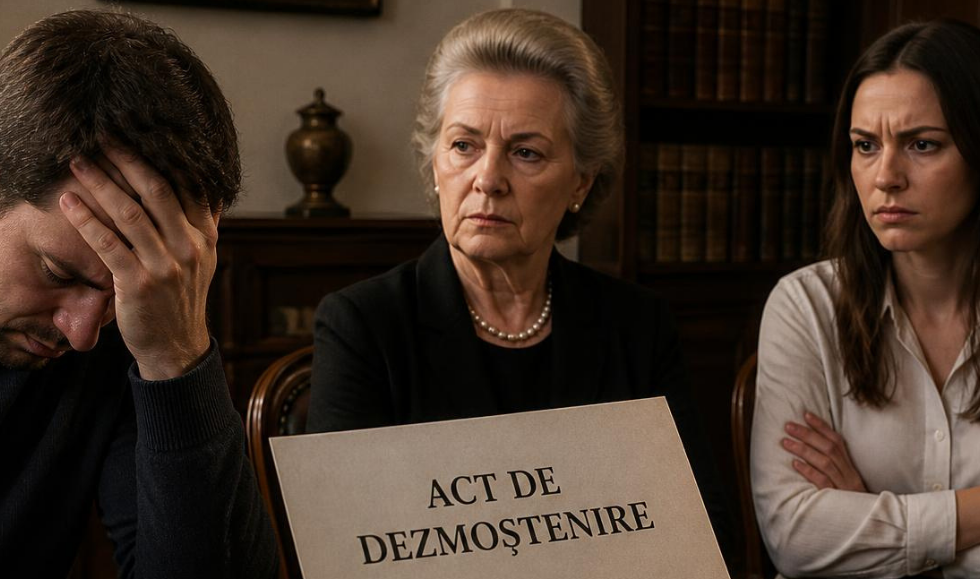
– The legal truth behind the 'I'm leaving everything to your brother/father' myth
We’ve all heard the famous line at least once after a heated family dinner: „Just you wait, I’ll disinherit you and you won’t get a dime from me!”. But legally speaking, would that actually be possible?
Given that this isn’t an American movie where a billionaire leaves their entire estate to a complete stranger, we must examine the situation in light of current Romanian legislation.
So, to put it briefly and directly: Parents cannot completely disinherit you, but there are a few exceptions.
The Civil Code safeguards the rights of the deceased’s direct heirs, establishing rules for statutory reserve.
What is the statutory reserve?
According to art. 1086 Civil Code, „The statutory reserve is the part of the inheritance assets to which reserved heirs are entitled by virtue of the law, even against the will of the deceased, manifested through liberalities or disinheriting acts.”.
In plain terms, the reserved share is that portion of the deceased’s estate set aside exclusively for forced heirs.
Who are these forced heirs?
Under current law, there is a special category of heirs to whom the law grants the right to that reserved share mentioned in the previous paragraphs.
The forced heirs are:
- the deceased’s descendants (children);
- the surviving spouse;
- privileged ascendants (the parents of the deceased).
How much does this share allocated to forced heirs represent?
According to the Civil Code, the forced heirship share for each heir is half (1/2) of the legal share they would have been entitled to had there been no will.
For example, if there are two children and no surviving spouse:
- Standard legal share per child: 50% (1/2)
- Guaranteed reserved share for the disinherited son: 25% (1/4) of the estate.
In the event that the deceased breaches this forced heirship share, and failing an amicable settlement, you are entitled to institute legal proceedings before the competent court, requesting the reduction of excessive gratuitous transfers.
Are there exceptions under which an heir may be fully disinherited?
However, the legal text outlines a scenario where a forced heir can be completely disinherited, thereby resulting in successoral unworthiness.
An heir can completely lose their right to the inheritance (or a portion of it) if:
- They have been criminally convicted of an offense committed with the intent to kill the deceased;
- They have been criminally convicted of committing, prior to the opening of the succession, an offense with intent to kill another person entitled to inherit who could have excluded or restricted the perpetrator’s right of inheritance;
- They were convicted of serious acts of violence, bodily harm, or attempts against the deceased;
- They have altered, destroyed, or falsified the testator’s will;
- They prevented the testator, by means of duress or fraudulent inducement, from executing, modifying, or revoking the will;
Unworthiness to inherit may, as the case may be, be classified as by operation of law or judicial.
Although Romanian law provides a safety net for forced heirs, situations vary from case to case, which is why I invite you to contact me without hesitation in the event that you require legal counsel!
 English
 Română